Briefing Note 01

How far back does the line run? Get a dated note for it.

Queue Length Monitor measures the queue from the gate outward on a satellite or aerial pass and sends you a numbered briefing note: where, how long, and the marked-up image it came from. It is for crossings and terminals that have no sensor on the lane.

Schematic: a line of vehicles on an approach road, measured from the gate back to the last vehicle gate → tailgateapproach
Fig. 1. Schematic only: vehicles receding from a gate. A note shows the real line on the real approach road.
GSD
≤0.5 m (VHR)
Cadence
Daily or on demand
Platform
VHR satellite / aerial
Spectral
RGB

How queue length gets reported now

Without a loop in the road or a camera on the gate, the length of the queue is whatever somebody tells you. The officer at the booth radios that it goes back a fair way. A haulier's dispatcher says his trucks have been sitting since morning. A patrol drives the approach road and gives a figure at the end of the shift. It goes into the log with a time beside it, and it is as good as the eyes it came from.

That is workable for a single crossing on an ordinary day. It stops working when you are the planner on the corridor and three crossings each report in their own way. One person counts vehicles, another counts kilometres, a third says "heavy". You cannot lay them next to each other, and a month later, when the review asks how bad the backup really got on the day the system went down, the file holds a remembered number and nothing to check it against.

For the crossing you name, a pass is scheduled, the queue is measured from the gate back to its tail on the image, and the length goes into a note with the picture it was read from. The figure is dated, it carries its own evidence, and the same method is applied to every crossing you ask about.
What a briefing note holds

  1. 2.1Queue-length estimate

    Per crossing or lane

    The length of the queue at the time of the pass, measured from the gate outward along the approach. Given per lane where the lanes can be told apart in the frame, otherwise for the approach as a whole.

  2. 2.2Marked-up image

    Image

    The pass itself with the counted extent drawn on it, gate to tail. If you doubt the figure, the picture is the evidence, and anyone in the office can see where the line was measured to.

  3. 2.3Dated log entry

    One page, numbered

    Crossing, date, time of pass, length, image reference. Written to sit in an operations file next to the shift log.

Three separate notes from three passes in one week, shown as unjoined points on a week line NOTE 01NOTE 02NOTE 03one weekno line between passes
Fig. 2. Each note reflects one pass. Several passes over a week give you several notes, not a continuous curve.

How it works

  1. 3.1Name the crossing or terminal

    You tell us which crossing or terminal gate, which approach and which lanes matter, and whether you want daily passes or passes on demand when something happens.

  2. 3.2A pass is scheduled

    We schedule a very-high-resolution satellite or aerial pass over the approach. Daylight and a clear sky are required. If a pass is blocked, it is rescheduled and no figure is estimated.

  3. 3.3The queue is measured

    The extent is read from the gate outward to the last waiting vehicle on the image.

  4. 3.4The note is delivered

    You receive the numbered note with the length and the marked-up image. You decide what it means for staffing, lane opening or the corridor briefing.

For the operations file and the corridor review

Use a note where you would otherwise write down a phoned-in figure. Notes from several crossings on one corridor can be set side by side, because each was measured the same way. An on-demand pass gives you a dated record for the review of whatever the line looked like on the day it was taken. For a trend, order repeat passes.

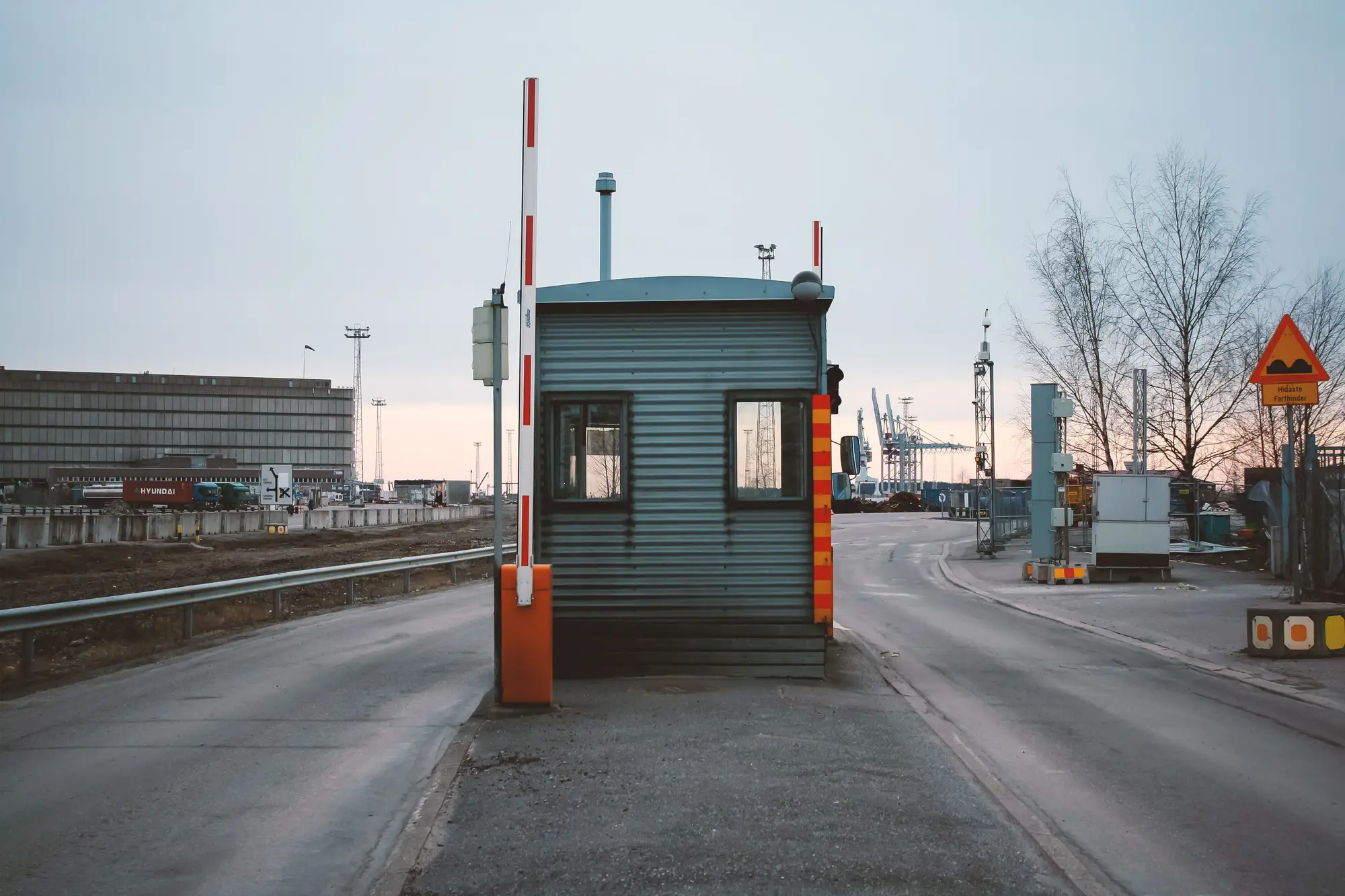
A gatehouse and striped barrier on an empty approach road at a port terminal, cranes in the distance

Limits

  1. 05.1One pass, one moment

    A note is a snapshot. It is not a live feed and it is not continuous monitoring. A queue that grew and cleared between two passes is not in either note.

  2. 05.2Length, not waiting time

    We measure how far the line stretches. We do not turn that into minutes of wait. Wait depends on how fast each lane processes vehicles, and that is not visible from above.

  3. 05.3Daylight and clear sky

    Optical imagery needs light and an open sky. Night, heavy cloud and haze block a pass. It is rescheduled, never estimated.

  4. 05.4Resolution

    At 0.5 m or finer a truck is many pixels long, so the extent of a line can be read. Individual vehicles in a packed, overlapping line are not counted to the unit, and what a vehicle is carrying is not visible.

  5. 05.5Lanes

    Freight and passenger lanes are told apart only where the lanes are visibly distinct in the frame. Where they merge, the note reports the approach as a whole.

  6. 05.6Trees, buildings, covered approaches

    A queue under a canopy or inside a covered facility is hidden from above, and the note says so rather than guessing.

Who it's for

For

  • Customs operations planners who log queue extent at a crossing that has no sensor
  • Freight logistics planners comparing crossings on a corridor
  • Terminal operations teams who need a dated record of a backup at the gate

Not for

  • Live wait-time displays or anything that has to update continuously
  • Predicting how long a driver will wait, or forecasting a queue
  • Crossings that already have loops, cameras or gate sensors you trust
  • Identifying vehicles, drivers or cargo

Questions before a pilot

Q1Is this a live feed?

No. Each note reflects a single pass. If you want a trend, order repeat passes and compare the notes.

Q2Does it give a wait time in minutes?

No. It measures the physical length of the queue. Minutes of wait depend on how fast the lanes process vehicles, which we do not observe.

Q3What if it is dark or cloudy on the day?

A pass needs daylight and a clear sky. A blocked pass is rescheduled. We do not estimate a length from a pass we could not see.

Q4Can it separate freight from passenger lanes?

Only where the lanes are visibly distinct in the frame. Otherwise the note reports the approach as a whole.

Q5How do we check a note against our own figures?

Pick a day when your officers log a queue length at the gate and compare it with the note for the same day. The marked-up image shows where the line was measured to, so a difference is easy to trace.

Q6Will it fit into our shift log or GIS?

A note is a numbered page with an image, built to sit in an operations file. We can discuss a file format that suits your GIS or spreadsheet. We do not write into your systems directly.

Q7Who owns the imagery and the notes?

Ownership and licence terms for the notes and the imagery are written into the pilot agreement before anything is ordered. If your legal team needs them, ask early.

Q8How is a pilot bought and priced?

The quote depends on how many crossings, how often and which imagery source. Tell us how your agency buys services and we will scope the pilot to fit.

Name a crossing, get a note.

Tell us which crossing or terminal gate you cannot see, and how often you would want a pass. We will tell you plainly whether a note can answer your question.

Start a pilot