Note · 16 November 2026
How to tell a fog delay from an inspection bottleneck in a border queue image
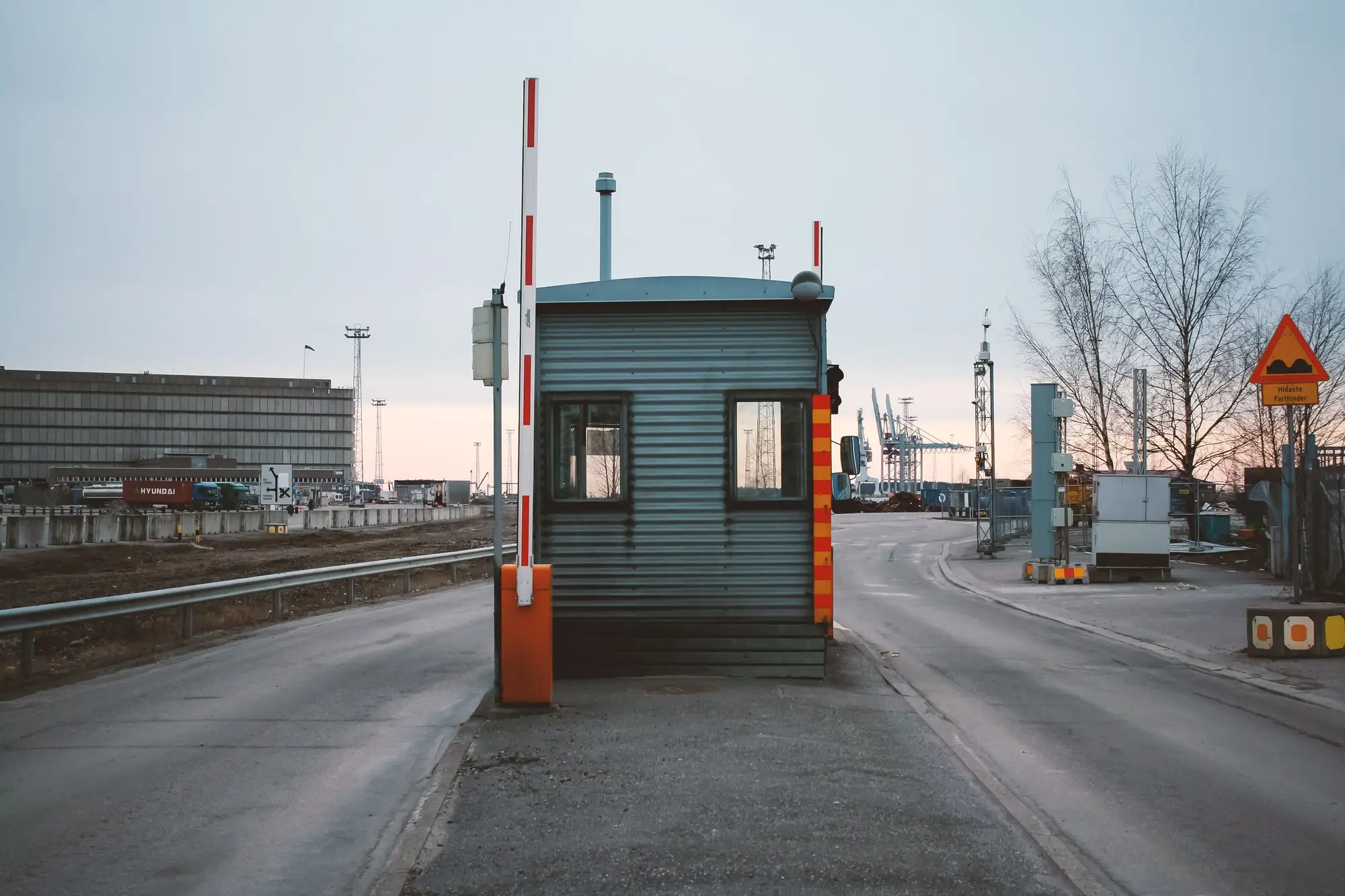
A dispatcher staring at a long line of trucks stacked back from a port of entry needs to know one thing fast: is this going to clear on its own, or is it going to sit there until someone opens another lane. Weather backups and capacity backups look similar from a distance. Both show a line stretching back from the gate. They don't behave the same way, and if you know what to look for in the imagery, you can tell them apart before you commit a driver to the queue or reroute a load to a different crossing.
How a weather-driven backup is built
Fog, blowing snow, and heavy rain slow a crossing by cutting visibility at the booths and on the approach roads. The booths themselves keep processing trucks at their normal rate, the slowdown happens upstream, as drivers ease off in low visibility. The queue that results tends to have a particular shape: it builds gradually over an hour or two, it's roughly even in spacing the whole way back, and it usually matches a visibility drop or a precip event in the official conditions data for that hour. If you pull an image during a fog event and compare it to one from the same crossing on a clear morning at the same time, the lane geometry at the booths is usually the same. What changed is everything upstream of the booths. Trucks are moving slower approaching the gate, and that's what's stacking the line, rather than any jam at the gate itself.
The tell in the image is uniformity. A weather queue doesn't usually have hard clusters or gaps. It's a steady line, thinning and stretching as conditions ease, and it tends to clear within a window that lines up with when the fog lifts or the storm passes. If you're trying to decide whether to hold a load or send it, that recovery pattern matters more than the queue length itself at any single moment.
How a capacity-driven backup is built
An inspection bottleneck looks different because the slowdown sits at a fixed point, the primary booths or the secondary inspection bay. The approach road beyond that point usually isn't the problem. You'll see the queue pinch and cluster right at the lanes that are running slow, with trucks backed up tightest closest to the gate and sometimes a visible split where one lane is moving and the one next to it isn't. This kind of backup doesn't track with visibility or precipitation at all. It tracks with staffing levels, manifest processing volume, a targeted enforcement push, or a scale that's down. It will often build and hold through a clear, sunny afternoon just as easily as it will through rain, because the cause has nothing to do with what the windshield can see.
The other giveaway is timing against the calendar rather than the weather report. A capacity backup tends to repeat on the same days or same shift windows, week after week, independent of conditions. If a crossing backs up every Monday morning regardless of forecast, that's a staffing or volume pattern, not a weather one.
Cross-checking before you act
The fastest way to confirm which type of backup you're looking at is to put the queue image next to a timestamp and a conditions reading for that hour. A long, even line that matches a visibility drop is weather. A pinched, clustered line that holds steady through good conditions, or that shows up at the same time slot day after day, is capacity. Once you know which one you're dealing with, the decision is different: a weather backup is usually worth waiting out, a capacity backup usually isn't going to open up on its own schedule.
The part most planners don't have is a repeatable way to see the queue itself, stretch and gap and all, without someone physically out at the crossing counting trucks. Queue Length Monitor pulls a VHR image of the approach on demand and hands back a numbered briefing note with the queue length estimate and the marked-up image it came from, so you're reading the actual shape of the line instead of guessing at it secondhand.
If you've got a crossing you're watching right now, run a pass and see what the queue is actually doing.